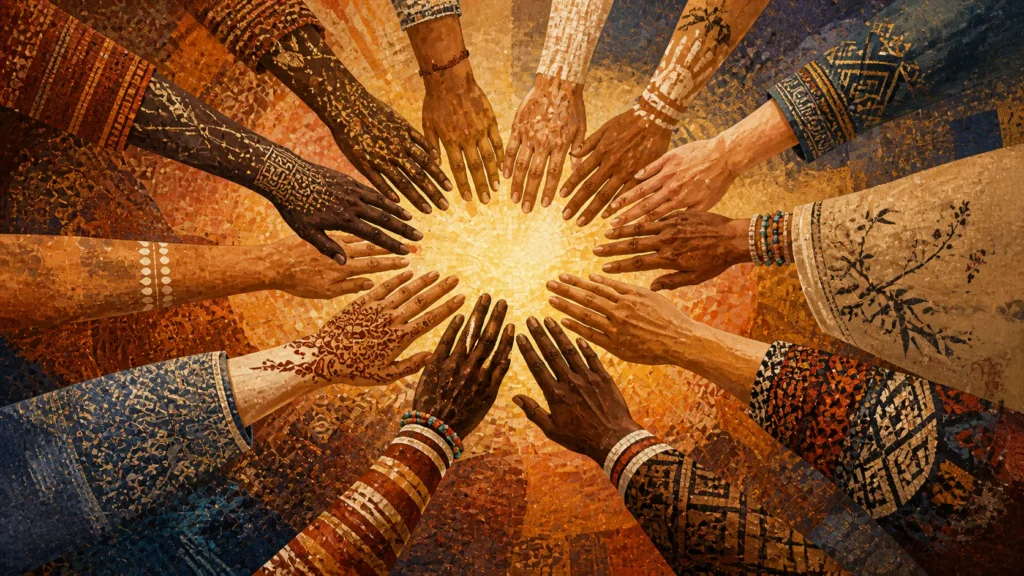
A Western Label on a Universal Experience
When most people hear the term PTSD, they picture a clinical diagnosis drawn from a psychiatric manual. The label itself, Post-Traumatic Stress Disorder, is a product of Western medicine, formalised in the American psychiatric system in 1980 and refined through subsequent editions of the DSM. But trauma, as a lived human experience, is far older than any diagnostic manual. People have been overwhelmed by catastrophic events since the beginning of recorded history, and cultures across the world have developed their own frameworks for understanding what happens when a person is broken open by suffering.
The problem is that when Western diagnostic tools get exported globally, they carry with them a set of assumptions about how distress should look, sound, and be described. Those assumptions do not always travel well. A Cambodian refugee who says she feels “wind overload” in her neck and fears it will carry illness to her heart is not describing anxiety in a way that maps neatly onto a DSM checklist. A Haitian man who speaks of his soul being frightened out of his body is not being metaphorical in the way a clinician might assume. These are coherent, culturally grounded explanations of real suffering, and dismissing or translating them too quickly risks missing the person entirely.
This matters not just academically but practically. Globally, millions of people exposed to war, displacement, natural disaster, and interpersonal violence will never receive a PTSD diagnosis, not because they are not suffering, but because the framework used to assess them does not fit their world. Understanding how different cultures name and make sense of trauma is one of the most important and least-discussed dimensions of what PTSD actually is.
Cultural Idioms of Distress: What They Are and Why They Matter
Researchers use the term “cultural idioms of distress” to describe the local, culturally specific ways that people communicate suffering. These are not simply translations of Western psychiatric symptoms into different languages. They are distinct conceptual frameworks, often embedded in cosmology, community, and the body, that carry meaning within a particular cultural context. The DSM-5 acknowledges their existence, but they remain poorly understood in mainstream clinical practice.
Take susto, a concept found across Latin American cultures. Susto, sometimes translated as “fright sickness” or “soul loss,” describes a state that follows a shocking or frightening event in which the soul is believed to have become dislodged from the body. Symptoms include fatigue, appetite loss, difficulty sleeping, and a pervasive sense of sadness and withdrawal. Sound familiar? To a Western clinician, this might look like a partial match for PTSD or depression. But the person experiencing susto is not describing a neurological response to threat. They are describing a rupture in their relationship to the spiritual world, one that requires a healer, not a therapist, to repair.
Similarly, khyâl cap, or “wind attacks,” is a Cambodian cultural syndrome in which a person fears that wind-like substances will rise through the body and cause catastrophic harm, including fainting, blindness, or death. This concept is often triggered by the same kinds of situations that would provoke panic in a Western framework, but the internal logic is entirely different. The person is not catastrophising in the cognitive-behavioural sense. They are drawing on a coherent physiological and spiritual model of the body that has been part of their culture for generations. Research published in cross-cultural psychiatry journals has consistently found that these idioms are not just colourful descriptions of universal symptoms, but genuinely distinct ways of organising and communicating distress that require culturally adapted responses.
Other examples include hwa-byung in Korean culture, a syndrome of suppressed anger that manifests physically in the chest and is often linked to prolonged interpersonal suffering; ataque de nervios among Caribbean Latino populations, characterised by intense emotional outbursts, trembling, and dissociation following acute stress; and dhat syndrome in South Asian cultures, where distress is expressed through fears about bodily depletion. Each of these carries its own internal logic, its own social meaning, and its own pathway toward healing.
The Limits of Universalising PTSD
One of the central debates in global mental health is whether PTSD, as defined by Western psychiatry, is a universal condition or a culturally specific one. The evidence suggests it is somewhere in between. There does appear to be a core cluster of trauma responses that show up across cultures: re-experiencing the event in some form, avoidance of reminders, and a state of heightened alertness or changed mood following exposure to extreme threat. The World Health Organisation recognises PTSD as a global concern, and its ICD-11 diagnostic criteria were specifically revised to be more cross-culturally applicable than earlier versions.
But the way those core responses are experienced, interpreted, and expressed varies enormously. In many non-Western cultures, distress following trauma is understood primarily through a social or spiritual lens rather than a psychological one. The question is not “what is happening inside my mind?” but rather “what has happened to my relationships, my community, my standing in the world, or my connection to the ancestors?” Healing, in this framework, is not a private therapeutic process. It is a communal and often ritual act.
In many African cultural contexts, for instance, trauma is understood as a disruption of ancestral bonds or community harmony. Healing ceremonies involving the whole community, music, movement, and spiritual invocation are not supplementary to treatment. They are the treatment. Imposing individual-focused Western therapy on someone whose understanding of selfhood is fundamentally relational can, at best, be ineffective and, at worst, feel deeply alienating.
This does not mean Western diagnostic categories are useless. It means they are partial. They capture something real, but they do not capture everything, and in diverse societies like Australia, where people from hundreds of cultural backgrounds may be seeking support following trauma, clinicians who rely solely on DSM criteria risk systematically misreading the people in front of them.
What This Means for How We Define PTSD
Bringing cultural diversity into the definition of PTSD is not about abandoning rigour. It is about expanding it. A truly comprehensive understanding of what PTSD is, and what it is not, has to account for the fact that human beings do not experience suffering in a cultural vacuum. The brain may respond to threat in broadly similar ways across populations, but the meaning a person assigns to that response, the language they use to describe it, the support they seek, and the path they take toward recovery are all shaped by culture.
For people from non-Western or multicultural backgrounds who are trying to understand their own trauma responses, this is genuinely important. If your experience does not match the clinical descriptions you have read, that does not mean your suffering is less real or less valid. It may simply mean that the framework being used was not built with your experience in mind. Your cultural understanding of what happened to you, and what needs to happen to restore balance, is not a barrier to healing. In many cases, it is the most direct route toward it.
For clinicians, researchers, and mental health advocates, the challenge is to hold both things at once: the utility of a shared diagnostic language that allows us to identify and respond to suffering at scale, and the humility to recognise that the map is not the territory. PTSD is a useful concept. But trauma is bigger than any single definition, and the people who carry it deserve frameworks that are wide enough to hold them.