
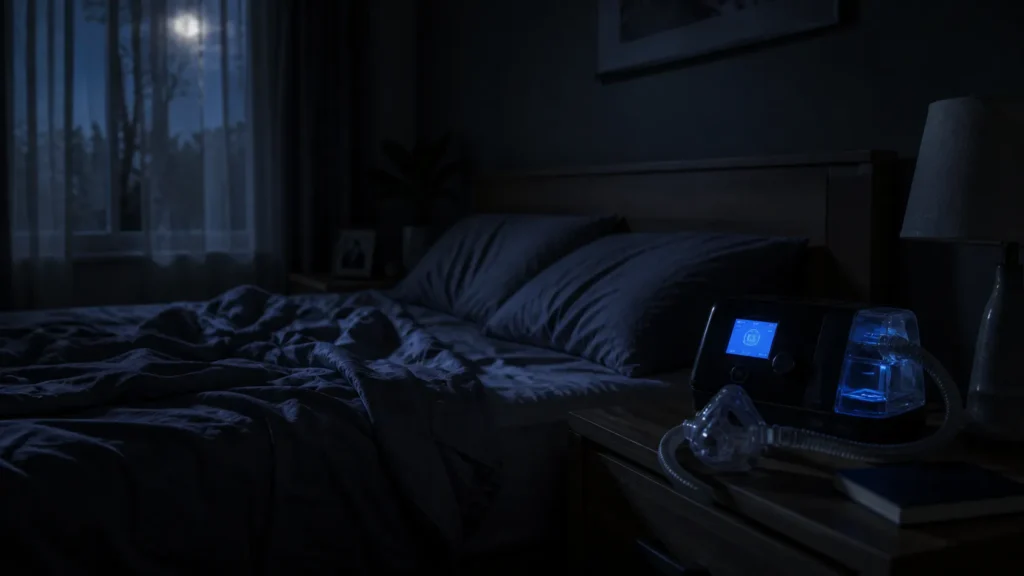
Two conditions that feed each other
Most people know that PTSD disrupts sleep. Nightmares, broken rest, and waking unrefreshed are well-recognised parts of the picture. What gets far less attention is the significant overlap between PTSD and obstructive sleep apnoea (OSA), a condition where the airway repeatedly collapses during sleep, causing brief but frequent drops in oxygen. Research suggests these two conditions do not simply co-exist; they actively make each other worse.
Studies in veteran populations have found OSA rates as high as 90% among those with PTSD, compared to roughly 20-30% in the general adult population. Even in civilian trauma survivors, the overlap is striking. This is not coincidence. There are biological reasons why PTSD creates conditions that favour OSA, and equally strong reasons why untreated OSA keeps PTSD symptoms entrenched.
Why PTSD raises the risk of developing OSA
PTSD produces sustained changes in stress hormone activity, particularly involving cortisol and noradrenaline. These changes affect muscle tone, including the muscles that keep the upper airway open during sleep. Chronically elevated noradrenaline, which is a hallmark of PTSD, alters how the brain controls breathing during REM sleep, the stage where airway muscles are already at their most relaxed. This creates a window of vulnerability that OSA exploits.
There is also a weight-related pathway. PTSD is associated with metabolic changes, disrupted appetite signalling, and reduced physical activity, all of which contribute to weight gain over time. Excess weight, particularly around the neck and upper body, is one of the strongest modifiable risk factors for OSA. So PTSD can quietly set the stage for OSA through several routes at once.
How OSA keeps PTSD symptoms locked in
Here is where the bidirectional relationship becomes clinically important. OSA fragments sleep architecture, repeatedly pulling the brain out of deep and REM sleep. REM sleep is not just rest; it plays a critical role in emotional memory processing. Research on REM sleep and emotional memory consolidation shows that disrupted REM impairs the brain’s ability to process and contextualise distressing memories, which is precisely the process that trauma recovery depends on.
In practical terms, this means a person with PTSD who also has untreated OSA may find that their distressing memories stay raw and vivid far longer than they otherwise would. The brain simply does not get the overnight processing window it needs. Psychological therapies that rely on memory reconsolidation can also be less effective when sleep architecture is this disrupted.
Beyond memory, repeated overnight oxygen drops from OSA increase inflammation and oxidative stress in the brain, particularly in the prefrontal cortex and hippocampus, two regions already compromised by PTSD. Evidence linking intermittent hypoxia to hippocampal damage suggests this overlap may accelerate cognitive difficulties that trauma survivors already face, including problems with concentration, memory, and emotional control.
The treatment gap this creates
Standard PTSD treatment protocols rarely screen for OSA as a matter of course, and sleep clinics rarely assess for PTSD. This means many people fall into a gap where neither condition is fully addressed. Someone may complete a course of trauma-focused therapy and still feel stuck, not because the therapy failed, but because undiagnosed OSA is undermining the neurological processes the therapy depends on.
There are also medication complications worth knowing about. Some medications prescribed for PTSD, particularly certain antidepressants and sedatives, can worsen OSA by relaxing upper airway muscles further. This is a nuance that matters enormously for people managing both conditions.
What actually helps
The good news is that treating OSA with continuous positive airway pressure (CPAP) therapy has shown promising effects on PTSD symptom severity, not just sleep quality. When the brain finally gets uninterrupted, oxygenated REM sleep, emotional processing can resume more normally. Some clinicians now advocate for screening both conditions together as a standard of care.
- Ask your GP for a sleep study if you have PTSD and consistently poor sleep quality, even without obvious snoring.
- If you are already on CPAP, let your mental health provider know; it may influence which treatments are prioritised.
- Be aware that the National Institute of Mental Health’s overview of PTSD acknowledges sleep disturbance as a core feature, which makes OSA screening a logical extension of any thorough assessment.
- People navigating this combination often find it useful to read about how PTSD affects the body in ways that go beyond the psychological, particularly when trying to explain the physical dimension to a GP or specialist.
- Weight management, positional sleep changes, and avoiding alcohol before bed are practical steps that reduce OSA severity while broader treatment is underway.
Managing PTSD and OSA together is more complex than managing either alone, but it is also more likely to produce real, lasting improvement. If your recovery has felt stalled despite doing the right things, this overlooked connection may be worth exploring with your doctor.